
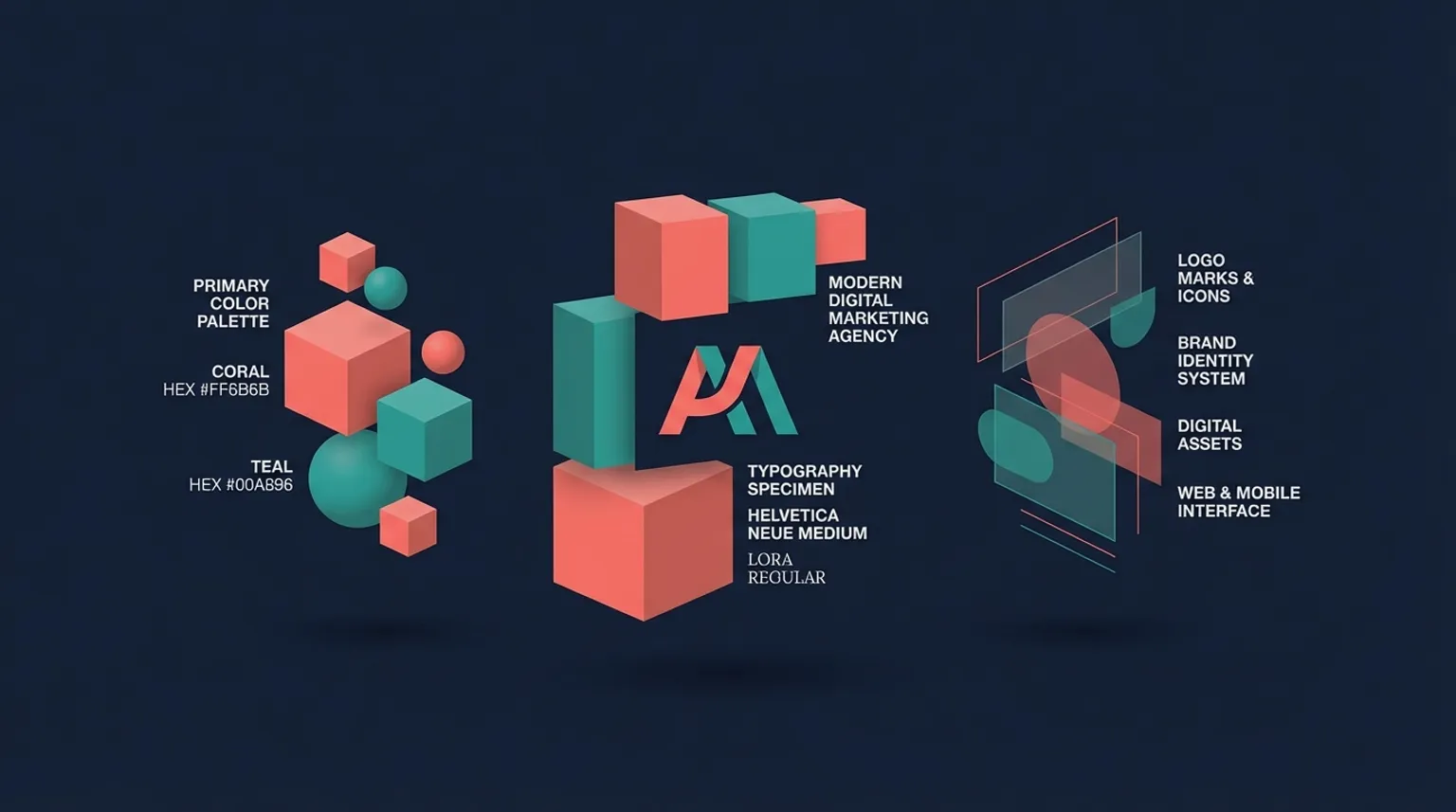
Build a Design System, Not Just Brand Guidelines
Most companies have brand guidelines. They sit in a PDF somewhere on Google Drive. Maybe a designer made them two years ago. They include a logo, a color palette, and some font choices. Nobody opens them.
This is the norm, not the exception. According to a Lucidpress (now Marq) and Demand Metric study, 95% of organizations have brand guidelines, but only 25% consistently enforce them. That means three out of four companies are paying for brand assets they don't actually use.
The problem isn't the guidelines. It's the format. A static PDF can't keep up with how brands actually get built day to day. Your social media manager needs ready-to-use templates, not a page telling them the hex code for your primary color. Your web developer needs reusable components, not a screenshot of how a button should look.
A design system solves this. It's a living collection of components, patterns, templates, and rules that your team uses to build everything. Think of it as the difference between giving someone a recipe and giving them a fully stocked kitchen with pre-measured ingredients.
The data supports the investment. According to Figma's research on the business value of design systems, organizations with mature design systems see up to 50% better efficiency for design teams and up to 47% better efficiency for development teams. Freshworks credited their design system with a 28% reduction in customer service costs. For large enterprises, connecting creative teams with optimized tools and governance can yield up to a 9x ROI over three years.
You don't need to be Figma-sized to benefit. What a small business design system actually looks like:
- Logo files in every format anyone could need (SVG, PNG, white, dark, icon-only) in a shared folder
- Color tokens defined in your website code, not just documented in a PDF
- Typography scale built into your site's CSS so heading sizes are always consistent
- Social media templates in Canva or Figma that lock brand elements in place
- Email templates pre-built with your brand's header, footer, and button styles
- A one-page quick reference anyone on the team can pull up in 10 seconds
The goal is to make staying on-brand the path of least resistance. When it's easier to use the template than to start from scratch, people use the template.
The enforcement problem
According to the same Marq brand consistency research, 81% of companies admit they still publish off-brand content. The fix isn't more rules. It's better tooling. When your website is built from a component system and your social templates are pre-loaded, off-brand content becomes harder to create than on-brand content.
Your Website Is the Hub Everything Flows From
Every ad you run, every social post you publish, every Google search result that shows your business eventually leads to the same place: your website. It's the one channel you fully control, and it sets the standard for everything else.
The data on first impressions is brutal. Researchers at Carleton University found that people form an opinion about a website in 50 milliseconds. That's 0.05 seconds. Before they read a word, before they scroll, before they consciously register anything, they've already decided whether your site feels trustworthy or cheap. The study, published in Behaviour & Information Technology (Lindgaard et al., 2006), showed that visual appeal ratings at 50 milliseconds and 500 milliseconds were highly correlated, meaning that gut reaction holds.
What drives that snap judgment? Design. The Stanford Web Credibility Project, one of the largest studies of its kind with over 4,500 participants, found that 46% of consumers assessed website credibility based primarily on visual design, including layout, typography, font size, and color scheme. The broader conclusion: 75% of users judge a company's credibility based on its website design alone. The average consumer paid far more attention to the superficial aspects of a site, such as visual cues, than to its content.
This matters for brand consistency because your website is where the brand promise gets tested. You can have a polished logo, a sharp Instagram feed, and a professional Google Business Profile. But if someone clicks through and lands on a website with different colors, a different tone, or a layout that feels outdated, the disconnect kills trust instantly.
The reverse is also true. When your website looks and feels exactly like what someone expected based on the ad, post, or search result that brought them there, you get a compounding effect. Every touchpoint reinforces the one before it. The 2025 Edelman Trust Barometer found that 80% of people trust brands they use, more than they trust business, media, government, or NGOs. But that trust has to be built through consistent, recognizable experiences across every channel.
Research on brand recognition, compiled by Marq, shows it takes 5 to 7 impressions for someone to remember a brand. If your website is visually inconsistent with those earlier touchpoints, you're resetting the clock every time someone visits. A consistent color palette alone can increase brand recognition by up to 80%, according to research from the University of Loyola.
That's why we build websites as systems, not one-off designs. When your web design is built from a defined set of brand tokens (colors, spacing, typography, component styles), every new page, landing page, or section automatically stays on brand. There's no guessing, no drift, no "does this match our brand?" conversations. The system handles it.
Cross-Channel Auditing: Where Most Brands Fall Apart
Here's a test. Open your website, your Google Business Profile, your Facebook page, your Instagram bio, and your most recent marketing email. Put them side by side. Do they look like the same company?
For a significant number of businesses, the answer is no. According to Salsify's 2025 Consumer Research Report (surveying 1,910 consumers in the US and UK), 54% of shoppers have abandoned a sale because product content wasn't consistent from one channel to the next. Even worse, 71% have made a return because the product didn't match the online listing. That's not a perception problem. It's a systems problem.
The inconsistencies are usually small and incremental. A logo gets uploaded at the wrong size on one platform. Someone updates the phone number on the website but not on Yelp. The brand's Google Business Profile description was written by a different person than the website copy, and the tone doesn't match. Over months, these small drifts add up into a brand that feels fragmented.
Here's a practical cross-channel audit checklist:
- Visual identity: Same logo version, same colors, same photo style across every platform
- Business information: Name, address, phone, hours, and service descriptions match exactly
- Tone and voice: The way you describe your business sounds like it was written by the same person
- Offers and messaging: Current promotions, taglines, and value propositions are aligned
- Profile completeness: No half-finished profiles sitting out there with placeholder content
For local businesses, the Google Business Profile is the most overlooked consistency gap. Your GBP is often the first thing someone sees, before your website, before your social media. If the photos, description, and branding on your GBP don't match what's on your site, you've introduced doubt before the customer even clicks through. Local SEO and brand consistency are more intertwined than most businesses realize.
Email is the other blind spot. Most businesses put significant effort into their website and social media but treat email like an afterthought. A branded email template that matches your website's visual identity creates a seamless experience from inbox to site. A generic plain-text email, or worse, an email with different branding, breaks the chain.
Real-world cost of inconsistency
In 2009, Tropicana replaced its iconic orange-with-a-straw packaging with a generic minimalist design. Customers literally didn't recognize the product on shelves. Sales dropped 20% in two months, costing roughly $30 million in lost revenue (some estimates put total damages at $65 million including recovery costs). In 2010, Gap replaced its classic logo with a Helvetica-and-blue-square design that sparked 2,000 negative comments within 24 hours and a parody site with 14,000 mock logos. The new logo lasted exactly six days before Gap reverted, eating an estimated $100 million. These are extreme examples, but the principle scales down. Even small inconsistencies erode the trust you've spent months building.
Brand Voice Specificity: Beyond "Professional Yet Approachable"
Open any company's brand guidelines and you'll see some version of the same thing: "Our voice is professional, approachable, and trustworthy." That describes every company. It describes no company.
A brand voice that's this generic is the same as having no brand voice at all. When three different people on your team write copy, they'll each interpret "professional yet approachable" differently. The result is a brand that sounds like a different person on every channel. Your website sounds formal. Your social media sounds casual. Your emails sound like they were written by a committee.
One of the best public examples of how to do this right is Mailchimp's Content Style Guide, which they've made fully open source. Instead of vague adjectives, Mailchimp defines their voice as "the experienced and compassionate business partner" they wish they'd had. They give specific rules: use active voice, write in plain English, avoid slang and jargon, and prefer the subtle over the noisy. The guide distinguishes between voice (which stays the same) and tone (which adapts to context). That distinction alone is more useful than a page of personality adjectives.
Defining a useful brand voice requires specificity. Not adjectives, but rules. Here's the difference:
Vague: "We are friendly and helpful."
Specific: "We write the way a knowledgeable friend would explain something. Short sentences. No jargon unless we define it. We use contractions. We don't say 'utilize' when 'use' works. We never start with 'In today's fast-paced world.' We reference specific data over general claims."
The second version is something anyone on the team can actually follow. It creates a consistent voice whether Taylor writes it, a contractor writes it, or an AI drafts it for review.
A practical brand voice document should include:
- We say / We don't say: Specific word choices and phrasings. ("We say 'fast websites.' We don't say 'blazing-fast digital solutions.'")
- Sentence structure rules: Average sentence length, use of contractions, active vs. passive voice preferences
- Content do's and don'ts: "We cite sources. We don't make vague claims like 'industry-leading.'"
- Channel-specific adjustments: Your website copy can be longer. Social needs to be punchier. But the underlying voice stays the same.
- 3-5 before/after examples: Show what off-brand writing looks like next to on-brand writing. This alone is more useful than a page of adjectives.
This isn't a branding luxury. It's a scaling tool. Coca-Cola understood this when they launched the "Share a Coke" campaign, replacing their iconic logo with popular names on bottles. The campaign worked precisely because it stretched the brand voice without breaking it. The playfulness was new, but the red, the script font, and the emotional warmth stayed consistent. The result: an 11% increase in U.S. package sales, a 2% bump in overall revenue (reversing a decade of decline), and over 500,000 user-generated photos on Instagram. Consistency gave them the foundation to take a creative risk that paid off.
Contrast that with what happens when consistency breaks. In 1985, Coca-Cola changed its formula for the first time in 99 years to launch "New Coke." The backlash was immediate and intense. The company received 1,500 angry calls per day (up from 400) and reversed course after just 79 days. The lesson, in the words of Coca-Cola's own executives: "We learned that Coca-Cola as a brand was not owned by the Coca-Cola Company. It was owned by the American people." Brand consistency is a promise, and people notice when you break it.
The Revenue Case for Getting This Right
Brand consistency isn't a "nice to have." The financial data is clear.
The most-cited number comes from the Lucidpress and Demand Metric partnership study, which surveyed over 400 brand management professionals: consistent brand presentation across all platforms can increase revenue by up to 33%. That's up from the 23% figure found in their 2016 study, suggesting the value of consistency is growing as the number of brand touchpoints increases. A follow-up Lucidpress Content Effectiveness Report found that over two-thirds of businesses implementing brand consistency programs reported double-digit revenue improvements.
McKinsey's data tells a similar story from a different angle. Their Business Value of Design report, which tracked 300 publicly listed companies over five years, found that top-quartile design performers achieved 32 percentage points higher revenue growth and 56 percentage points higher total returns to shareholders compared to their industry counterparts. Companies with a strong and consistent brand image outperformed their competitors by nearly 20% in total shareholder return.
The consumer behavior data backs it up from multiple angles:
- The 2025 Edelman Trust Barometer reports that trust is as much of a purchase consideration as quality and price, and 73% of people say their trust in a brand would increase if it authentically reflected today's culture
- Salsify's 2025 research shows 87% of consumers will pay more for a product from a brand they trust, but 54% will abandon a sale entirely if the brand experience is inconsistent across channels
- Capital One Shopping's branding research found 57% of consumers will spend more with a brand they feel connected to through consistent experiences
- It takes 5 to 7 impressions for someone to remember your brand. Inconsistency resets that counter every time.
Airbnb is a strong example of what happens when a company commits to fixing inconsistency. In 2014, Airbnb partnered with DesignStudio to overhaul their brand around the concept of "belonging." They introduced the "Belo" symbol, commissioned a custom typeface (Airbnb Cereal), defined a signature color ("Rausch," named after the street of their first headquarters), and redesigned every digital touchpoint to align. The rebrand wasn't just cosmetic. It gave every team, from engineering to marketing to customer support, a shared system that ensured every customer interaction felt like the same company. Airbnb's growth from a scrappy startup to a $70+ billion company happened in tandem with their investment in brand consistency.
You don't need to be a national brand for these dynamics to apply. If you're a service business in Washougal, Vancouver, or Portland, your version of this might look smaller but the principle is identical:
- A potential customer sees your Google ad. The ad looks polished and professional.
- They click through to your website. The site has different colors, a different feel, and stock photos that don't match the ad creative.
- They bounce. You paid for that click and got nothing from it.
Or the opposite scenario: someone finds your Google Business Profile, reads your reviews, clicks to your site, and everything matches. The colors, the tone, the professionalism, the specific services listed. They call. They book. The sale happened because every touchpoint told the same story.
This is measurable. Track your conversion rate before and after aligning your brand across channels. Businesses that do this consistently report not just higher conversion rates but also shorter sales cycles. When people trust the brand at first contact, there's less friction in every conversation that follows. If you want help building that kind of system for your business, that's what our custom web design and local SEO services are built to deliver.